A Master Class with Thrive’s Carrie Lester
If you’ve ever taken a class from a great teacher, you know what it’s like to spend an hour with Carrie Lester, CEO of Thrive IRC, Inc. Lester walks through the color-coded halls of the organization’s offices on Fifth Avenue like a college professor who knows her subject thoroughly and thrives on sharing her insight. She shares so much information that you simultaneously start to feel smart and can’t wait to learn more.

Thrive was founded in 1989 as Substance Abuse Council then changed its name to Substance Awareness Center before landing on the name that describes both its way of working and its results. Thrive is respected as the leading prevention, recovery, and treatment center for substance use disorders in Indian River County. Its accreditation by CARF International recognizes the organization’s adherence to internationally recognized standards of care. Thrive’s mission is to “protect and empower our community by providing resources, prevention strategies, and recovery services that address substance misuse and behavioral health, promoting long-term wellness.”
According to the National Survey on Substance Use and Health, one in six people will struggle with substance use in their lifetime, while only 15% of those who need treatment will ever access it. Lester calls those numbers “unacceptable.” She provides data- and mission-driven leadership that is manifested throughout the organization, including the color-coded walls in the office.
Lester starts the tour in the coral-shaded hallway, where to “protect and empower” means “to lead.” She credits her predecessor for setting the tone for how the organization operates—“Do best practices, always follow the science, don’t make up what you do.” A three-person data team led by the Chief Impact Officer measures and evaluates program outcomes, using pre- and post-program testing, and evaluates results for statistical significance. Thought leaders use the data to drive strategy.
The people working in the bright blue corridor “offer help.” They greet clients entering the facility for meetings, training, treatment, or drug-testing. Thrive collects samples and runs in-house drug tests for businesses doing pre-employment testing, as well as the juvenile justice, child welfare, and criminal justice systems. In addition to providing earned income, the partnerships cement Thrive’s integration with the courts. Lester is proud of the fact that a recent accreditor noted that a high standard of care was palpable. “If you’re coming in for a drug test it’s not your best day,” Lester says. “We meet people with dignity and respect.”
In the green hallway, “to protect and empower” means “to educate.” Roughly half of Thrive’s budget is spent on evidence-based programs geared toward prevention. “The science is clear that substance use disorders are preventable,” Lester says, adding that the delay of onset of use in youth significantly reduces the likelihood of developing a substance use disorder across a person’s lifespan. “We say substance use disorders are a disease of adolescence,” she explains. “That’s where they start.” Last year, Thrive provided over 1,400 lessons to more than 7,700 students across twenty-two locations. High school participants demonstrated a 92% increase in knowledge about substance harms and a 32% increase in healthy coping strategies after completing the programs. Thrive also provides a seven-week training program for the fifty-five and older community, which is seeing an increase in substance use disorders, and an evidence-based “Strengthening Families” program designed to address risk factors for problem adolescent behaviors.
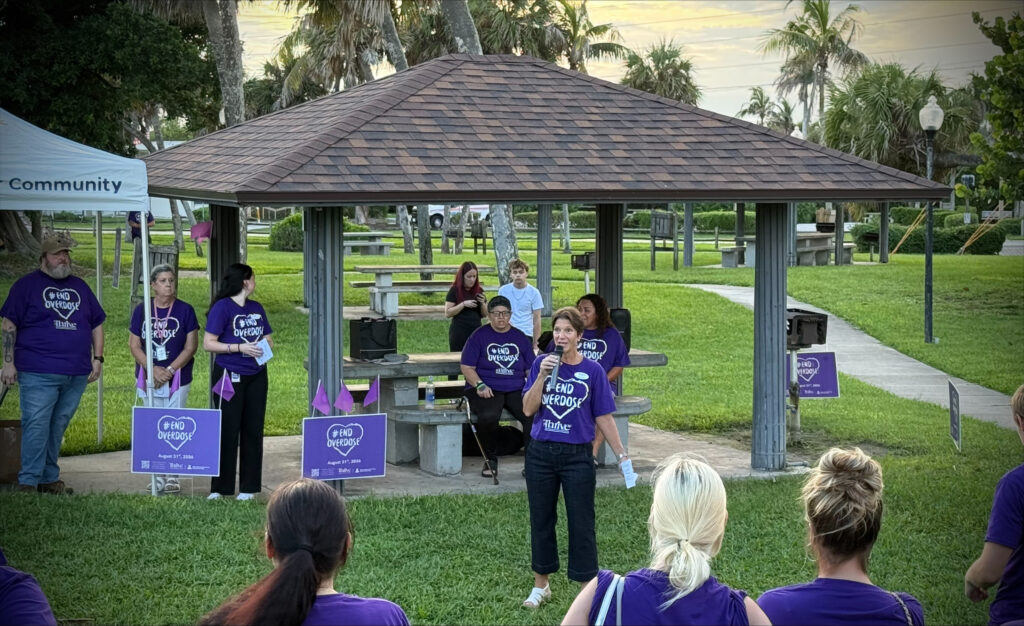
Creating awareness, the bright gold hallway, is another pillar in Thrive’s mission. The organization leads Indian River County’s Prevention Coalition, a group of roughly forty key stakeholders that meet monthly to identify and catalyze prevention and early-intervention efforts. An active youth coalition includes approximately seventy students who learn leadership and advocacy skills. Thrive also partners with law enforcement to provide pre-arrest diversion, a program that offers evidence-based intervention to young people. In lieu of being finger-printed and entering the justice system, youth receive services focused on accountability and building skills. “We see great outcomes,” Lester says. “We have a 95% successful completion rate and less than 5% recidivism rate for that program.”
The final pillar of Thrive’s mission is “to heal.” Walking down the purple hallway, Lester describes the various treatment programs the licensed clinicians provide, including two recovery homes, a highly structured day treatment program, and flexible outpatient treatment services. Thrive is also working to make Narcan, a nasal spray that rapidly reverses an opioid overdose, the “CPR of overdose.” Five thousand kits were disseminated into the community last year to prevent overdose deaths. A CRAFT program offers services to families and friends of those dealing with substance use issues. A group of “certified peers” are charged with providing “assertive outreach” by meeting the vulnerable population where they are, including recovery homes, the hospital, the jail, and through housing providers like The Source and Camp Haven. Lester says, “We get out into the community and share the seeds of hope that recovery is possible and there are multiple pathways. We want people to know that there is hope and healing and help out there.”
Lester’s lesson in substance use prevention, treatment, and recovery doesn’t end with the tour of the office. It continues with a case-study in mission-driven organizational leadership. Two years ago, the county commissioners sought guidance on the use of opioid settlement funds. Thrive convened the Opiate and Substance Use Taskforce and engaged key community stakeholders in combing through data to prioritize needs. Education and access to care emerged as the highest priorities.
That work resulted in a centralized intake and respite project that will come to fruition in early 2027. A new facility will open, providing twenty-four/seven access to treatment and referral services as well as twenty respite beds to provide crisis care. In addition to addressing an immediate need, Lester expects the center to provide even more data about gaps in the county’s continuum of care, pointing the way toward future improvements.
As a person with lived experience, Lester thrives on the success stories she sees in her office every day and doesn’t let much keep her up at night. “I’m in recovery,” she says, “so that which I can’t control I do need to turn over and let go.” That said, the dynamic funding landscape and the potential impact of Amendment Three provide challenges and spotlight the need for philanthropy. “Those philanthropic dollars, unrestricted dollars, allow us to navigate a tumultuous funding environment,” she says, explaining that federal, state and local grant dollars carry uncertainty as well as administrative burdens. It’s the philanthropic dollars that allow organizations like Thrive to think outside the box.
“It’s important for people to understand that this work takes a whole community to be invested and to care enough to move a needle,” Lester says, wrapping up class for the day. Substance use disorder “is a chronic condition that is highly treatable. If we as a community can start to embrace people in that way and respond with understanding and not judgment, we can come a long way in helping people.”
There is plenty of homework for our community to complete. If we take Carrie Lester’s teachings to heart, we’ll be on our way to earning an A plus.