Every Family Needs a Healthy Start
Once a month, while the rest of us are going about perfectly ordinary days, a group of fifteen to twenty community stakeholders is gathered around a table, combing through medical records to figure out why babies have died.
Led by Indian River County Healthy Start Coalition, this group of ob-gyn doctors, representatives from the Sheriff’s Department, the Department of Families and Children, and a handful of other organizations are charged with reviewing medical records to understand every fetal or infant death that occurs in Indian River County.
The case review team is participating in the Fetal and Infant Mortality Review, or FIMR, a community-based process designed to examine every fetal (stillbirth) and infant death (when a child dies before his first birthday) in Indian River County. The goal is to identify gaps in the system of care and use that information to improve the health and well-being of women, infants, and families.
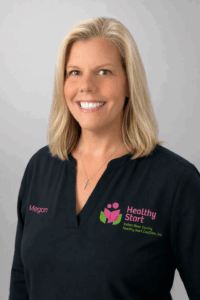
Megan McFall leads the meetings. She brings knowledge rooted in her experience working as a registered nurse for twenty-nine years, twenty of them spent working in maternal and child health, labor and delivery, and postpartum care.
Three years ago, to the surprise of everyone who knew how much she loved nursing, she traded in her scrubs to become the CEO of Healthy Start Coalition. Established in 1993, the organization’s mission is “to establish and support a local system of care that optimizes the health of moms, babies, and their families living in Indian River County.” The move made sense to McFall. She knew that many of the bad outcomes she experienced with families in the delivery room had their start well before a woman went into labor.
In fact, she explains, the road to a healthy pregnancy begins long before you are thinking about starting a family. Young adults who age out of their pediatric visits too often fail to establish a primary care physician, leaving potential health conditions like diabetes or high blood pressure untreated. “Women and men are walking into pregnancy very, very unhealthy,” she explains.

That’s where Healthy Start comes in. While not primarily clinical healthcare providers, they offer an “umbrella of support” to ensure families have and know how to access the care they need. They provide in-home outreach that extends from pregnancy through a child’s fifth birthday; health education and “Parents as Teachers” programs that are available until a child is three years old; and even doulas who will walk alongside a family from pregnancy through the postpartum period. Fathers can receive one-on-one support and attend weekly group meetings where they can get tips, share struggles, and celebrate successes.
That’s just the beginning. Healthy Start’s Babies and Beyond programs include lactation education (both in the hospital and at home); a weekly support group for and led by moms; myriad childbirth education classes; and a post-partum nurse home visitation program to protect mothers during the period when 60% of all maternal mortality cases occur.
Healthy Start’s newest program, Nurse Case Management, was launched last October to provide an “extension of the medical office.” Case managers have access to medical records of enrolled families and contact them after visits to answer questions and help navigate follow-up care. For example, if a doctor tells a woman she has gestational diabetes, the case manager can explain what that means and help the woman procure the supplies she needs to monitor and treat the condition.
“I know our programs work,” McFall says, but you don’t have to take her word for it. Recently, a number of families shared their stories about how Healthy Start’s programs have helped them. One woman learned strategies for understanding and dealing with toddler tantrums; another learned what to expect at each stage of her child’s development; and another was comforted by receiving nursing care at home during the post-partum period. A father discovered joy in reading to his son, and a family enrolled in the Doula Program felt prepared and confident going into delivery.
If McFall could wave a magic wand to improve the outcomes for women and babies in our community, the first thing she would do is guarantee that “Every pregnant mother and family with a child under the age of five was enrolled and actively participating in one of our programs.” By every, McFall means every. As the cover of her latest five-year strategic plan proclaims, “Every mother. Every father. Every baby. Every family.”
“We’re not just here for the underserved,” she emphasizes, eager to dispel a common misconception. “When a baby passes away, that baby has no idea how much money is in your bank account, or if you have a 401k, or if you are homeless.” Her goal is to have “every single mom and dad plugged into one of our evidence-based programs and following those programs with fidelity.”
In the two-year period comprising 2024 and 2025, there were nineteen fetal deaths and fourteen infant deaths in Indian River County, for a total of thirty-three cases. In 2022 and 2023 there were thirty-six, with the same number of fetal deaths and seventeen infant deaths.
During FIMR meetings, community partners review records from every case and ask some two hundred questions from a national database to identify factors that could have contributed to the death. For example, did the mother receive prenatal care in her first trimester? Did the mom have transportation issues that caused her to miss appointments? Insurance coverage, mental health, stress, housing—these and other factors are all considered as the team looks for opportunities to strengthen the system of care and improve future outcomes.
The final question is the one that breaks McFall’s heart. “We say,” she explains, “could this death have been prevented?” If the answer is yes, she checks to see if the family was enrolled in any of Healthy Start’s programs. “What pains me every single time is when we say yes, and then you look to see whether the mom was enrolled in one of our programs, and the answer is no.”
In the 2024-2025 data, 69% of the fetal deaths and 36% of the infant deaths were deemed preventable. In” 100% of the thirty-three cases,” McFall explains, “those women were not enrolled in one of our evidence-based programs. … It’s why it’s so important for people to know who we are and what we do.” If every single family were enrolled in a Healthy Start program, she says, the county would “cut our fetal and infant mortality rates in half.”
In Indian River County, the mortality review reveals that the majority of preventable fetal and infant deaths are due to lack of pre-conception care; instability in housing, transportation, and other unmet basic needs; and “late entry” to prenatal care. That knowledge is causing a shift in Healthy Start’s priorities, leading to a stronger focus on helping families meet basic needs.
McFall would like to do one more big thing with that magic wand. Too many women don’t have reliable transportation for prenatal visits. She would like to see a “prenatal bus” capable of providing “full scope prenatal care” on wheels. “I would love, love, love for there to be a hub in every high-risk community, every high-risk zip code,” she says. While the project falls outside Healthy Start’s immediate scope, McFall is hopeful another community partner will see its value and find a way to realize this ideal.
Rest assured that McFall isn’t sitting back waiting for a magic wand to appear. She and her team are working hard every day to prevent bad outcomes for moms, dads, and families in Indian River County. We can help by encouraging every young family we encounter to get to know Healthy Start. We can also use our time and treasure to support Healthy Start and the many organizations in Indian River County dedicated to making lives better. We can imagine and work toward a brighter day when the Fetal and Infant Mortality Review team meets and doesn’t have much to talk about.