Peace of Mind, A Cause to Get Behind

A link on the county website welcomes newcomers to Indian River, where “A Picture Perfect Paradise Awaits You!” In so many ways, paradise is an apt description. With miles of pristine beaches, an A-rated school district, and top-flight cultural institutions like Riverside Theatre, McKee Botanical Garden, and Vero Beach Museum of Art, it’s easy to see why that word gets tossed around.
What that word doesn’t reveal is that the suicide rate in Indian River County (19.8 per 100,000 people), is higher than both the state of Florida (15.5) and national rates (14.4). Hospitalizations for mood and depressive disorders for children under eighteen are similarly grim, at more than 1,000 per 100,000, compared to roughly half that for the rest of the state.
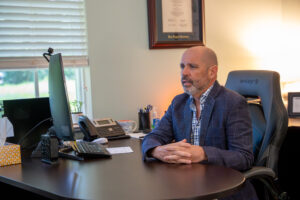
Dr. Philip Cromer, psychologist and Chief Executive Officer of Mental Health Association in Indian River County, sums up the situation. “We live in paradise,” he says, “but we are not without our problems.” He describes the “tremendous need” for mental health services and explains that it is growing. “What we’re seeing across both adults and children is that the acuity, the severity is much more” than it has been historically. Where once a family might have come in seeking treatment for a child, Cromer explains, now often the whole family requires services.
He offers a handful of potential reasons for the increase, including lingering effects of the pandemic, the local housing crisis, and the closures in recent years of both Suncoast Mental Health Center and the University of Florida Center for Psychiatry and Addiction Medicine in Vero Beach. “The mental health crisis is real,” he says. “There is a tremendous need for mental health services in this county, in the state, in the country.”

That’s where the Mental Health Association comes in. Founded in 1958, the organization’s mission is “To provide immediate access with no barriers to mental health care.” Today, more than fifty employees serve the Treasure Coast, including licensed mental health counsellors, licensed social workers, a doctor, and a psychiatric nurse practitioner. Students with bachelor’s and master’s degrees working toward licensure round out the team, and Cromer serves as the psychologist on staff. “We like to think of ourselves as the tip of the spear for mental health care in our county,” he explains.
There are many moving parts in the organization. The Walk-In and Counseling Center offers immediate, free, no-appointment mental health screenings to anyone in need of services. Cromer explains, “When a person walks in the door, a miracle happens. You walk in and you tell someone that you need to be seen and you’re seen immediately. No barrier, no wait.” Friends and family concerned about a loved can also walk in to consult with the mental health professionals on staff. In addition, the center provides ongoing psychotherapy and psychiatry visits, resource case management, and a variety of support groups, including a mood and anxiety group, a women’s group, and a group for veterans.
The Parent and Child Center provides mental health services to children, teens and families. It offers free mental health screenings as well as ongoing therapy, psychiatric support, academic skill-building, education about suicide and mental health awareness, and a parent’s group.

In addition to the Walk-In Center and the Parent and Child Center, the Mental Health Association also operates Our House, a drop-in center for people struggling with persistent mental illness. The peer-led center provides a welcoming space where people can receive support and acceptance 365 days a year.
When a person is in distress, the last thing they can afford to do is wait for care. Together, the association’s programs are designed to remove that barrier. “We want to have mental health services with no barriers,” Cromer states, including cost. Funding is available for uninsured or underinsured patients, and the staff work with clients individually to identify resources to support ongoing mental healthcare needs.
Cromer, who also serves as the psychologist for the Mental Health Court, describes the overall mental health continuum of care in Indian River County as strong. “It’s challenging, but it’s strong,” he says. He points to generous donors and supporters as well as a broad network of community partnerships to explain his answer. “No one is siloing here. … The nonprofits here in town collaborate and work together. We’re trying to fill the gaps as they pop up.”
That cooperation extends beyond the nonprofit organizations in the community. For example, when the county was faced with the loss of two major mental healthcare service providers, the Indian River County Hospital District convened community leaders to seek solutions. Cromer names the school district, county commissioners, Cleveland Clinic, saying, "that’s really something very special about Indian River County, there’s such a wonderful collaboration with all of us.”
The county website’s visitor page describes Indian River as “one of America’s happiest seaside destinations,” and that’s a great message for visitors. Those of us who live here, though, have an obligation to acknowledge that our best self as a community is still a work in progress. “We can’t do it without you,” Cromer says. “If you want a happy, healthier Indian River County with our kids going back to school with no problems and zero suicides, get involved. Don’t sit back, take action.”
That’s a message we can all get behind.