The Clock is Ticking: 3+5+24+410
No one likes talking about evictions. If you’re a renter struggling to pay the rent, an eviction draws an indelible line between being housed and unhoused. If you’re a landlord, it’s an unpleasant but necessary part of doing business. For the sheriff’s deputies tasked with removing people from their homes, it can be one of the most dangerous assignments in police work. For those working to reduce homelessness, it’s a failure—a missed opportunity to help before the worst thing happens. For the rest of us, it’s just sad.
Three
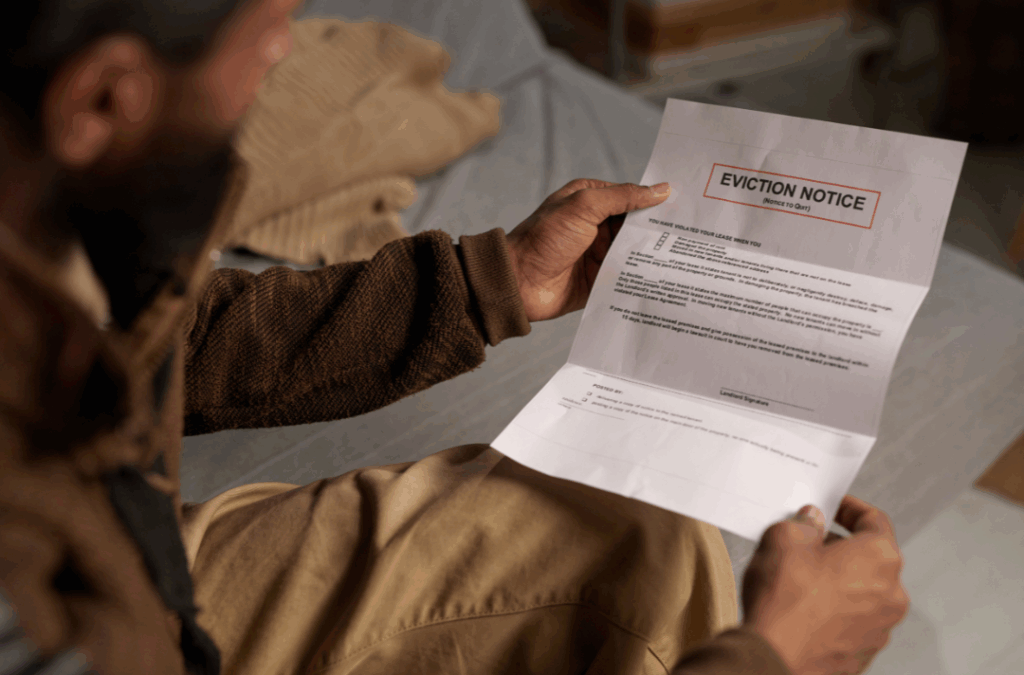
In Florida, when a tenant can’t pay the rent, the countdown clock to eviction starts ticking when a landlord delivers a “Three Day Notice to Tenant” telling a person eviction is imminent. No data exists to capture the story that has unfolded before that moment. Presumably, the most compassionate landlords have worked with their renters to try to keep them housed. By law, eviction proceedings can, and court records show they sometimes do, begin as soon as the first rent payment is missed. For Donna Pembroke (a real person whose name has been changed), the clock started on September 24, 2025, when she was notified that she had three days to pay her past-due August and September rent, totaling $3,700.
Five
On October 1, the court issued an eviction summons for Ms. Pembroke and her 78-year-old diabetic mother. When the notice was served on October 3, the clock started ticking again. Ms. Pembroke now had five days to complete “THE THINGS YOU MUST DO” as itemized in the standard summons she received. The most critical thing was to pay the Clerk of Court the outstanding rent owed. As with every eviction, Ms. Pembroke also had an opportunity to document the reasons why she believed she shouldn’t be forced to move or to request a judge to intervene if she disagreed about the amount due.
Ms. Pembroke responded October 8, within the five-day window, explaining that she had been ill and in and out of the hospital for much of July, causing her job to place her on unpaid leave. She asked for extended time to attempt to get a loan to cover the back rent plus an additional two months in advance. In the note she apologized to the landlord, begged the court to allow her to stay in her home, and said, “I have nowhere to go.” She added that she was “scared” to have her mother “be homeless.”
The language on the summons isn’t subtle. In all caps, it explains: “IF YOU DO NOT DO ALL OF THESE THINGS SPECIFIED ABOVE WITHIN 5 WORKING DAYS…YOU MAY BE EVICTED WITHOUT A HEARING OR FURTHER NOTICE.”
What Ms. Pembroke didn’t do within the five-day window was pay the rent. Failing that, it didn’t matter that she and her elderly mother would likely become homeless. As a sampling of other cases shows, it also doesn’t matter that a tenant claims the landlord has failed to respond to safety problems, or that a tenant has eight children, or that a woman who has paid rent faithfully since 2018 hit a temporary rough patch during her mother’s extended illness and subsequent death. The law is efficient – if you don’t pay the rent, you’re out.
The countdown clock expired for Donna Pembroke and her mother on October 20. The landlord filed a motion for default, and the judge issued a writ of possession, the final step in Florida’s streamlined process.
Twenty-Four
The writ of possession orders the sheriff’s department “to remove all persons from the property” after serving a 24-hour notice. We don’t know if the two women were still there when the deputy arrived or where they slept that night; it’s possible the Red Cross helped them stay in a hotel room or one of the local shelters found them space. We do know that affordable housing is scarce in Indian River County, and that having an eviction on your record makes it even harder to find a place to live. Most likely, on October 21, the number of homeless people in our county increased by two.
Four Hundred Ten
Four hundred ten eviction claims were filed in 2024, more than one every day of the year. The simplicity of the process dictates that almost none of the cases go to trial. Presumably, in some instances, the tenant is able to pay the rent and remain housed. However, data from the sheriff’s office for the same period shows 267 distinct eviction calls, suggesting that more than 65% of the total filings end with the tenant being removed from the home. Even if we assume the best possible outcome for the other 35%, the homeless population could be increasing by as many as twenty-two people per month.
Who are those 267 people? How many of them were children? How many of them were elderly? How much did they owe, and how late was the rent? Were they able to find alternate housing? Unfortunately, it’s impossible to answer those questions. There is no system for tracking eviction outcomes. In Indian River County, the best a person with a lot of time and some spreadsheet skills can do is determine the number of cases opened and closed, the address of the property in question, and the names of the plaintiffs, lawyers, and defendants involved. No other information is captured.
What Can We Do?
A national coalition including, among others, Georgetown’s Civil Justice Data Commons, the Stanford Law School Legal Design Lab, the Beeck Center for Social Impact + Innovation, and the National Low Income Housing Coalition have issued eight recommendations for improving eviction data. The ideas focus primarily on creating necessary infrastructure at the national, state, and local levels to standardize the information and operationalize data collection. It is possible their efforts will pay off at some point in the future, but in Indian River County, the clock is ticking.
Could we use the information we do have as a starting point? Could the eviction summons be served with a list of support agencies? Could high-incidence apartment complexes be targeted with information on how to get help before the first rent payment is missed? Could county housing services coordinate with the County Clerk’s office to initiate applications for emergency rent assistance whenever an eviction is filed? Could landlords develop and share a set of best practices for dealing with tenants who can’t pay the rent?
Indian River County has a robust ecosystem of nonprofit organizations working to prevent and mitigate the worst effects of homelessness. Evictions and their resulting trauma make that work harder. Through the end of September 2025, the sheriff’s department has already knocked on an additional 207 doors. In November, one of those knocks resulted in the tragic loss of a dedicated public servant and a local business owner. We think our community can do better. It’s time for all of us to work together to reset the clock.