The Salvation Army: Serving Lunch with a Side of Hope
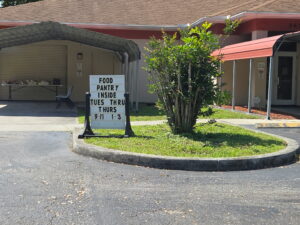
“Are you new to Vero?” the greeter asks. “No,” the woman answers. She’s wearing black jeans and a cute top, and her shoulder length blond hair shows just a little gray. She could be any middle-aged woman out running errands, stopping to pick up some quick groceries. “But I’m new to this,” she says.
This is the food pantry at Salvation Army, which operates every Tuesday, Wednesday and Thursday, serving roughly forty people each day. The Salvation Army picks the food up every Monday from Treasure Coast Food Bank. A cart is already loaded with groceries, including frozen meat, milk, and an array of pantry staples. The woman appears bewildered; she keeps trying to give things back. “It’s just me,” she says, “I don’t need this much milk. I don’t need all this bread.” A volunteer nods understandingly. She tells her she can return every thirty days.
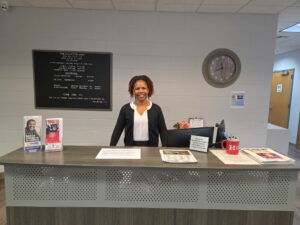
Beyond the food pantry, Subrena Perrotte, social services and case worker, greets people as they arrive and helps figure out what they need. Along the wall in front of her desk is a shelf of donated toiletries and other supplies from CVS that are available for the taking.
Zenaida Wills, program coordinator fondly known as “Mrs. Z,” explains that lately a lot of new people have been coming in, and many of them are working families. They don’t know what resources are available, she explains, and they are embarrassed that they need help. “I probably have at least two people per week crying in my office,” she says.
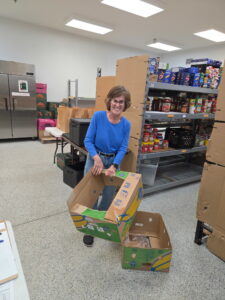
Wills, who has been with the Salvation Army for eighteen years, leads the Pathway of Hope initiative, which represents an intentional shift away from solely addressing the symptoms of poverty to also attacking its root causes. Through this program, the Salvation Army provides ongoing case management to individuals to address barriers to self-sufficiency and “break the cycle of crisis.” They partner with other community organizations to help people access vocational training and employment opportunities, achieve and maintain housing stability, and learn the basics of financial literacy and budgeting.
While long term stability is the desired outcome, Wills and her colleagues also provide assistance in resolving immediate needs, like paying utility bills, or sometimes, when funds are available, helping people make rent. She maintains copies of IDs for homeless people in case their documents are lost or stolen and provides a “homeless letter” a person can use to get a discount if they need a new ID. She can video chat with someone who just needs support and remembers helping one woman who simply needed a safe place to grieve without upsetting her children. Just knowing that help is available can make a difference. “It’s hopelessness that wears you down,” she says.
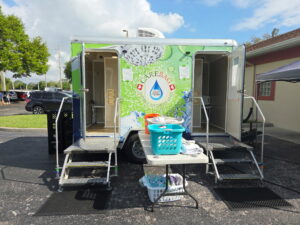
Flavia Souza-Pereira, office manager and human resources generalist, explains that the Salvation army “is here to serve in times of need.” This Wednesday morning, while the food pantry distributes groceries out front, volunteers from First Methodist Church wearing OLYN (Operation Love Your Neighbor) t-shirts hand out shower supplies around the back. By 10:45, nineteen people had already come in, and one more GoLine bus was expected to arrive soon. People can shower and change into fresh clothing stored in two trailers parked across the lot.
In the kitchen, additional volunteers in matching t-shirts are preparing the day's food and serving people already seated in the dining hall. Every Monday, Wednesday and Thursday the Salvation Army’s feeding program, run by local churches, provides hot meals to at least 120 people. Individuals can also take up to four meals to go. Donated charging stations around the room are filled with cell phones, helping people stay connected. Another one outside can charge an e-bike or scooter.
The list of ways the Salvation Army helps people is nearly as long as the list of the sorts of help people need. A scrapbooking club and sewing class provide companionship to some forty women who come in once a month. Fifteen to thirty people receive free haircuts every Monday, Wednesday and Thursday. Twenty-five children attend a free summer camp. A bus picks twelve children up for an after-school program. On Wednesdays, kids learn to play instruments in a brass band and play at church services on Sundays.
This past winter, the Salvation Army opened its cold shelter program on twenty-two nights. The organization also provides disaster services, a thrift store, “Angel Tree” help for families around the holidays, and backpacks to help families with extra food needs over the summer.
On this Wednesday morning, Ty, a regular at the feeding program, stops to share his story. He’s been coming for meals for the past few years, ever since his life derailed when his wife was killed in a hit-and-run accident. He comes for the food, but it’s clear the sense of belonging he feels is just as nourishing. “This is the best organization in Vero,” he says. “Everyone needs this.”
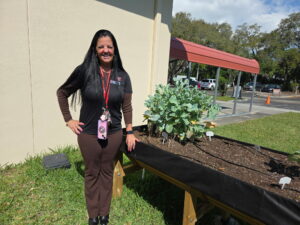
Souza-Pereira agrees. “We open our doors for people to come in and see that there is hope,” she says. In fact, The Salvation Army treats hope as “a measured outcome” in its work. It’s baked into every meal served and packed inside each bag of groceries picked up by regulars or by the woman who needed help for the first time this morning. It’s even present outside the building, in a series of raised beds of kale, peppers, and tomatoes struggling back to life after this winter’s bad freeze. On their own, the plants have a slim chance of surviving. With the Salvation Army’s help, however, it looks like they are going to make it.