The View from the Street
“Why don’t they just get a job?” We’ve all heard someone say that when they see a homeless person asking for help by the side of the road. When Chris Harbolt, outreach case manager for Homeless Services Council (HSC), sees that question in an online comment, he has to “tape his thumbs together” to keep from typing an angry response.
He can tell you exactly why that person doesn’t just get a job.
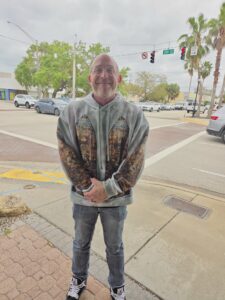
That person you see asking for spare change on the corner, Harbolt says, probably “used a log as a pillow last night. He hasn’t had a shower in a month, and the only clothes he owns are those on his back and in his backpack, because the rest of them were thrown out when he was evicted. He doesn’t have money to go to a laundromat to get them cleaned.”
Those aren’t the only hurdles. That homeless man panhandling, Harbolt continues, “doesn’t have an address, he probably doesn’t have an ID, and he probably doesn’t have the twenty-five bucks he would need to get one, even if he could track down his social security card or birth certificate” to prove he’s who he says he is.
“People have no idea,” Harbolt concludes, “how hard it is to start from square one.”
He should know. Harbolt spends most of his working life outside, looking for people at square one and helping them take that first step. He and his colleagues at Homeless Services Council help individuals find housing and access other resources. HSC operates under the widely accepted “Housing First” model, which eschews the idea that people “need to be ready for housing.” Instead, it promotes the practice of establishing stable housing as a precursor to solving other problems.
Despite coming under recent threat, that model has been widely accepted since it was first embraced by the George W. Bush administration in 2004. Numerous studies have shown it to be both more successful in achieving long-term housing stability and reducing system costs than approaches which require employment and treatment prior to providing housing.
Harbolt, who interacts with anywhere from ten to fifteen people in need of help on a typical day, explains that the number of homeless people dealing with addiction is “a lot less than society tends to think.” Last year, with funds from an emergency service grant flowing, he was able to help anywhere from one to four people a month move into housing. “Only a couple of them,” he says, were dealing with substance abuse issues.
The vast majority were people who had jobs. They became homeless when “something happened”—work hours were cut, a roommate who was paying half the rent took off, a relationship ended, or a spouse died. What had been affordable rent suddenly became too expensive. Then, once they had been evicted, raising money to pay the first and last month’s rent and a security deposit became impossible. Harbolt recounts one instance in which a man was trying to move into a 900-square-foot, one-bedroom apartment, and faced move in costs (consisting of first and last months’ rent plus a security deposit) totaling $9,800.
In addition to helping people secure housing, Harbolt and his colleagues at HSC help clients access other resources. A person may need help registering for social security, or applying for veterans’ benefits, or seeking mental health services or treatment for addiction.
While the latter group represents a minority of the homeless people Harbolt encounters, he’s uniquely positioned to assist them. No stranger to addiction, he spent fifteen years living on the streets in Chicago. He overdosed nine times, he says, and those are “just the times that are on record, when I ended up in a hospital.” He suspects there were others.
In 2013, a friend helped him get to Florida and into detox, then a halfway house. His life changed, he says, when he “learned to shut up.” Instead of fighting good advice, he says, “I learned to say OK” to people who were offering help. “You thought you were the inventor of the wheel your whole life,” he explains, “and it turns out you’re a passenger on the bus.”
Once he became sober, Harbolt spent nine years as an employee at a treatment center, first doing hands-on work as a group facilitator, then climbing the rungs into management. Eventually, finding himself too far removed from the work of helping people, he took a step back and changed directions.
Today, his work includes acting as street outreach coordinator for the county’s opioid abatement program. The state’s settlement with Purdue Pharma over its role in the country’s opioid crisis provides housing funds for individuals undergoing addiction treatment. Harbolt meets clients in early recovery and helps them find housing, often in area sober houses. Then, as people move to the next stage of recovery, he helps them access funds to aid in the transition.
His own journey to sobriety is an asset in his work. “You can’t fake the experience,” he explains. “I can tell when someone isn’t giving me the whole story.” People are often reluctant to discuss addiction; Harbolt encourages them to break through that hesitation to “open the door” to available services.
Fortunately for the people Harbolt helps, the successes keep him going. He wishes more people understood that homelessness “can happen to anybody.” He has a better question to replace the sarcastic ones he reads online. “The one thing every individual citizen can ask,” he says, “is how can I help?”